
KTH: Joint Modeling of Static and Dynamic Occupancy for Intelligent Transportation
Researchers at the Royal Institute of Technology in Stockholm are solving dynamic SLAM with Transitional Grid Maps (TGMs). By using Ouster OS1 digital lidar to model static and dynamic occupancy, the team eliminated map "ghosting" in busy traffic.
Building a map is the first step for any autonomous vehicle. In a controlled warehouse or an empty parking lot, this is relatively straightforward. But the real world is rarely static. Pedestrians cross streets, cars merge into lanes, and trams rumble through intersections.
For most Simultaneous Localization and Mapping (SLAM) algorithms, this movement is "noise." Traditional systems struggle to differentiate between a permanent wall and a temporary truck. The result? "Ghosting" or "smearing" in the map that causes the vehicle’s localization to drift, and in some cases, fail entirely.
To solve this, researchers at KTH Royal Institute of Technology in Stockholm developed a new way for machines to understand motion. By combining Ouster digital lidar with a sophisticated probabilistic framework, they are helping autonomous systems see through the chaos of urban traffic.
The Challenge: The "Ghost" in the Map
When a lidar sensor captures a moving object, standard SLAM algorithms often try to incorporate that object into the static map. If a car drives past your sensor, the algorithm might "smear" that car across the lane, creating a phantom obstacle that isn't actually there.
For an autonomous vehicle, these ghosts are dangerous. They degrade the accuracy of the map and make it impossible for the robot to know exactly where it is. To reach safety and reliability at scale for autonomous city driving, we need maps that can ignore the temporary and focus on the permanent.
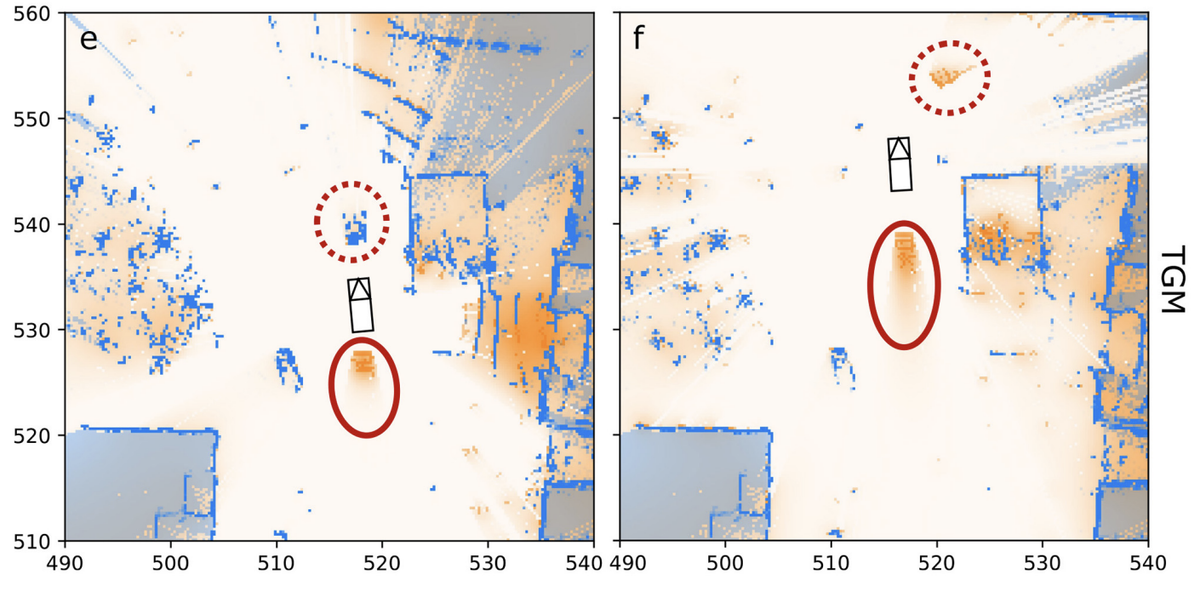
The TGM correctly classifies moving vehicles as dynamic (orange), preventing them from becoming part of the static map (blue).
The Solution: Transitional Grid Maps (TGMs)
The team’s breakthrough lies in Transitional Grid Maps (TGMs). Instead of treating every point as a static piece of geography, TGMs use Bayesian inference to model the probability of occupancy.
Think of it as a smart filter for reality. The framework jointly models static and dynamic occupancy, predicting which parts of the environment are likely to stay put and which are just passing through. This allows the vehicle to build a clean, high-fidelity map of the city while simultaneously tracking the moving actors within it.
The Setup: OS1-32 in Action
To put this theory to the test, the researchers equipped a Volvo XC90 with an Ouster OS1-32 digital lidar sensor. They deployed the vehicle in some of Stockholm’s most challenging environments, including busy campus intersections and transit corridors shared with heavy tram traffic.
The choice of digital architecture was critical. Because Ouster sensors provide high-resolution, structured 3D data, the TGM framework had the precision it needed to:
- Filter Out Dynamic Noise: By identifying moving cars in real-time, the system prevented them from "smearing" the underlying static map.
- Maintain Precision in Traffic: The vehicle stayed perfectly localized even when surrounded by a sea of moving actors.
- Scale to Complexity: The system improved SLAM performance in highly dynamic scenarios where legacy analog sensors and standard algorithms typically fail.
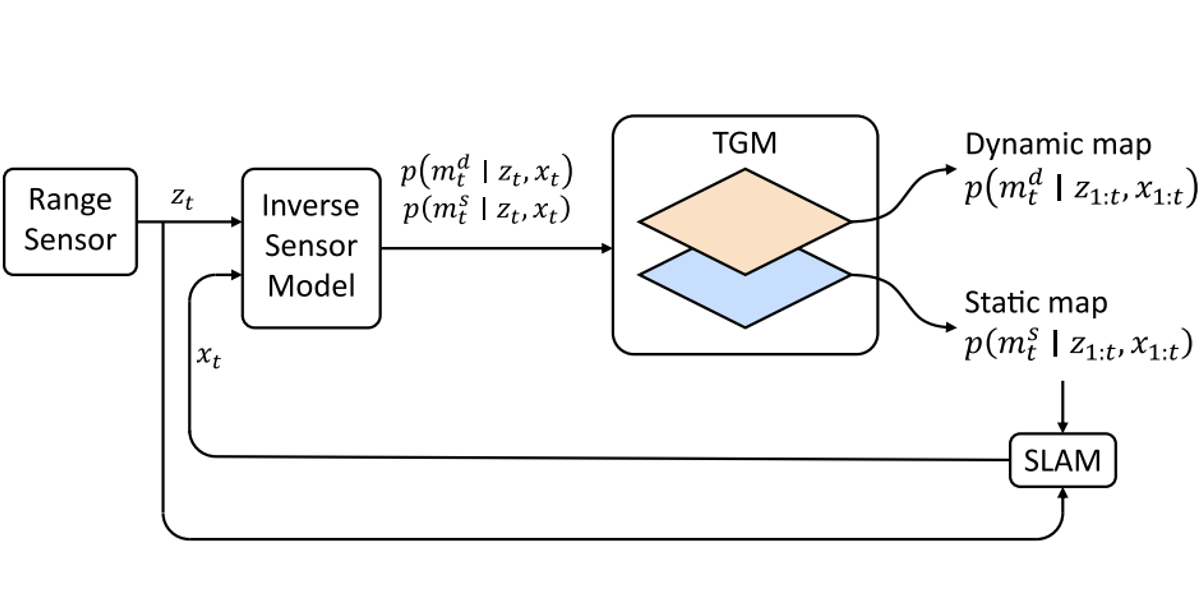
System overview of the integration between the proposed TGMs and SLAM approach.
The Outcome
Some of the most innovative breakthroughs in Physical AI start in the lab. This research was supported by our Premium DACH Partner, General Laser, who serves as a vital bridge between our digital hardware and the academic community in Europe.
By providing the technical support and hardware integration necessary for the Volvo XC90 platform, General Laser helped the KTH team move their research out of the lab and onto the streets of Stockholm.
Read their paper, published in IEEE, here.
Accelerate Your Research
We are proud to support the next generation of breakthroughs in autonomy and perception. University labs and research institutions can access exclusive, pre-approved pricing on our full suite of digital lidar sensors. Reach out to our team about your use case and we can work together to find an appropriate fit.