
Calibrated Reflectivity
Calibrated reflectivity is an 8-bit lidar packet field that scales measured signal photons by range and sensor sensitivity to estimate target reflectivity. Factory-calibrated sensors report higher reflectivity accuracy; sensors without factory reflectivity calibration use default calibration values and may have lower accuracy.
Note: If using Rev 7 sensors, use Firmware v3.0.0 or later. Rev8 sensors (including OS1-MAX) require Firmware v4.0 or later.
Read GET /api/v1/sensor/metadata/calibration_status to check your sensor’s reflectivity calibration status:
Contact support@ouster.io with questions about hardware eligibility for calibrated reflectivity.
Reflectivity Calibration Improvements
Reflectivity calibration version 2 (V2) combines a calibration improvement with a firmware improvement in firmware v3.2 and later. It improves calibrated reflectivity performance across all ranges, with even greater improvement in the near range due to an updated calibration process. Only sensors factory-calibrated on firmware v3.2 or later have V2 support.
The default behavior uses the latest available reflectivity calibration version. If directed by Ouster Support, the calibration version can be selected with GET /api/v1/sensor/config/{param} and PUT /api/v1/sensor/config/{param} using the parameter manufacturing_calibration/reflectivity_version.
Valid values are:
LATEST- use the latest available calibration version. This is the default and recommended setting.V2- use reflectivity calibration version 2.V1- use reflectivity calibration version 1.V0- use reflectivity calibration version 0.
The selected value restricts the maximum calibration version used. For example, if V2 is selected but the sensor only has V1 and V0 calibration data available, V1 is used instead.
Warning: Changing
manufacturing_calibration/reflectivity_versioncan affect reflectivity measurements and should only be done under guidance from Ouster Support.
Reflectivity Data Mapping
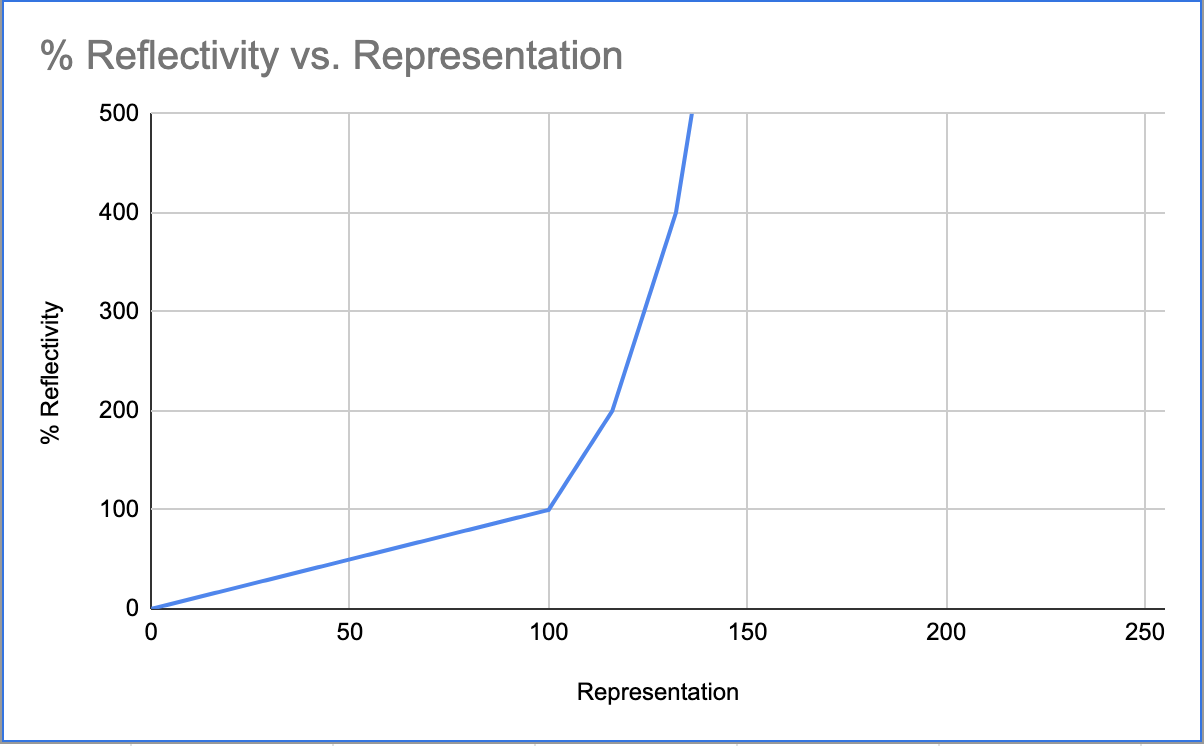
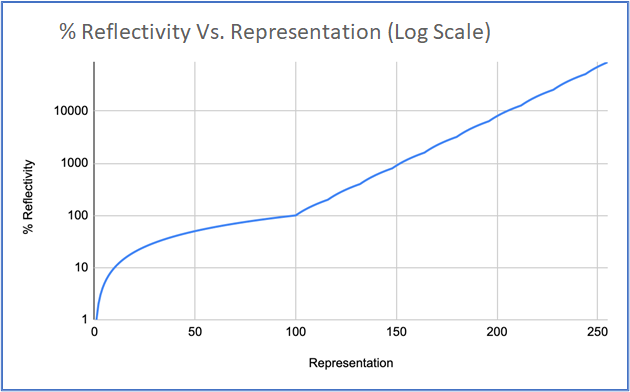
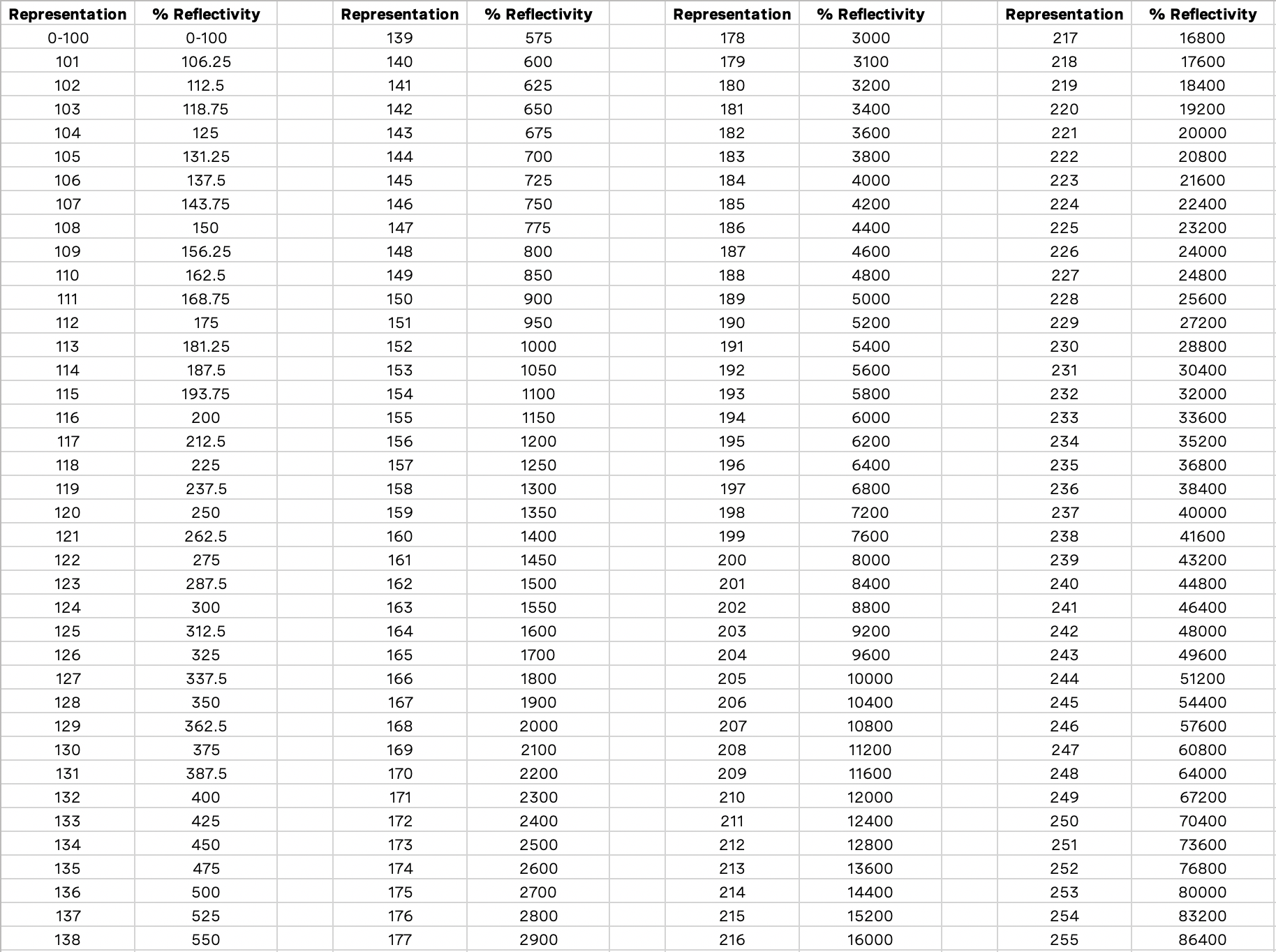
Reflectivity values 0–100 map linearly for Lambertian targets (0–100% reflectivity). Values 101–255 use log₂ mapping with linear interpolation for retroreflective targets. The value 255 corresponds to a retroreflector 864× stronger than a 100% Lambertian target.