
Heat Sources & Paths
Heat Sources & Paths
Where Does the Heat Come From?
There are two primary heat-dissipating assemblies in the sensor:
- The Optical Turret — containing the lasers and receivers.
- The Base Assembly — containing the computing, communication, and power.
The Optical Turret dissipates heat to both the TOP CAP and the SENSOR BASE. The Base Assembly conducts most of its heat to the SENSOR BASE.
It is important in any sensor mounting integration design to accept heat from both the TOP CAP and SENSOR BASE.
Another important heat source factor to consider is the Sun. If the sensor will be operating in full sun, you will need to account for the solar load (~1000 W/m²). In testing, solar load reduces the maximum operating temperature by approximately 8°C. See Sunshade Concept Design for possible solutions.
Where Does the Heat Go?
Standard Heatsinks
The sensor ships with two standard heatsinks:
- The base heatsink and mounting plate — referred to as HEATSINK-BASE.
- The radial finned or halo heatsink modular caps — referred to as HEATSINK-RADIAL or HEATSINK-HALO.
Both the Heatsink-Radial and Heatsink-Halo have the same thermal performance.
It is also possible to create custom heatsinks for your specific integration, as long as they adequately dissipate the heat from the sensor. For more information contact the Support team.
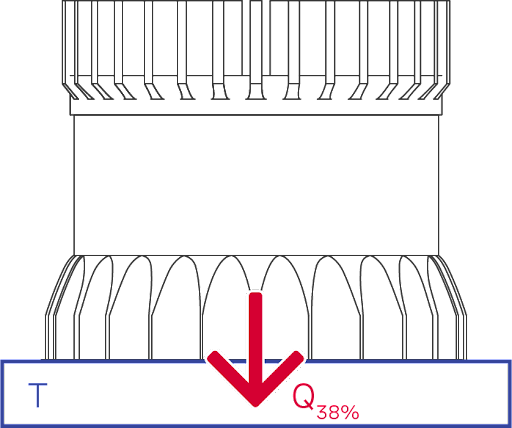
In the reference test conducted under Forced Convection (0.5 m/s) with standard heatsinks, 38% of the heat is conducted into the HEATSINK-BASE, while the remaining 62% convects to the air through the HEATSINK-RADIAL, SENSOR BASE, and WINDOW.
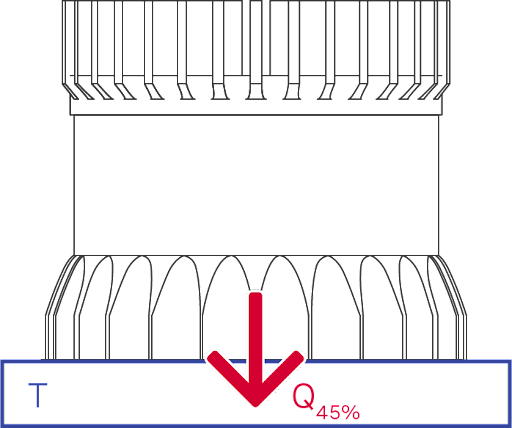
For Free Convection (Stagnant Air) with standard heatsinks, 45% of the heat is conducted into the HEATSINK-BASE, while the remaining 55% convects to the air through the HEATSINK-RADIAL, SENSOR BASE, and WINDOW.
Clamshell Heatsink
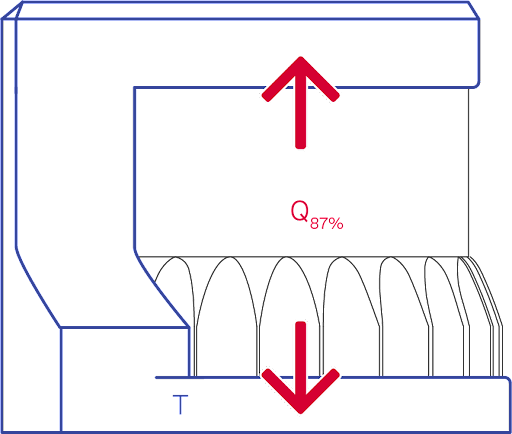
The clamshell design provides a reference for an integrated installation where heat dissipation is accomplished primarily through conduction into a vehicle chassis.
In the reference test under Free Convection (Stagnant Air) with the clamshell heatsink, 87% of the heat is conducted into the HEATSINK-CLAMSHELL, while the remaining 13% convects to the air through the HEATSINK-CLAMSHELL, SENSOR BASE, and WINDOW.